Remember when carrying a pager made someone look incredibly important?
If it beeped, you checked it, maybe found a phone, returned the call, and moved on with your day. Simple.
Fast forward to today where we all carry tiny supercomputers in our pockets that buzz, vibrate, light up, and demand attention every few minutes. Between texts, notifications, social media, emails, and group chats, phones have become constant companions and if we are not intentional, they can quietly become constant classroom distractions, too.
In a special education classroom, every adult matters at every moment.
Our students rely on us to notice the subtle things: a glance that signals frustration, a student trying to communicate, a behavior escalation beginning to build, or a tiny academic victory that deserves immediate praise. Being fully present is not just helpful in special education, it is essential.
That is why having a clear, supportive cell phone policy can completely change the feel of a classroom.
And no, it is not about being controlling or unrealistic. It is about creating a classroom environment where everyone understands expectations, feels supported, and can stay focused on students first.
Clear Expectations Prevent Big Problems
One of the biggest mistakes schools make is waiting until phone use becomes an issue before addressing it. Haveing teacher and paraprofessional cell phone guidelines can help.
By then, frustration has already built up.
Instead, set expectations early and revisit them often. A quick conversation during staff orientation, after long breaks, or anytime routines begin slipping can make a huge difference. When everyone understands the expectations from the start, there is far less confusion and far fewer awkward conversations later. The key is clarity.
Staff need to know exactly:
- When phones can be used
- When they should be put away
- Why the expectations matter
- What consistency looks like across the classroom team
Let’s be honest, unclear expectations usually create more stress than the phones themselves.
Your Team Needs the “Yes,” Not Just the “No”
One reason phone policies sometimes fail is because they focus only on restrictions.
But adults need balance, too.
It is completely reasonable to allow phones during:
- Lunch breaks
- Planning periods
- Scheduled downtime
- Emergencies
- Approved instructional purposes
In fact, phones can absolutely support instruction when used intentionally. Timers, communication apps, behavior tracking tools, reinforcement systems, and data collection apps can all be valuable classroom supports.
When people know there is a designated time to check messages or respond to personal needs, they are usually much more focused during instruction.
A supportive policy feels far more effective than a punitive one.
Out of Sight Really Does Matter
We have all done it. “I’m just checking one thing.” But one quick glance at a notification can easily turn into several distracted minutes.
During instruction, transitions, behavior support, and student interactions, phones should truly be out of sight completely, not sitting face-up on a desk waiting to light up every thirty seconds.
This small shift creates a noticeable difference in engagement. Students notice when adults are fully present. Teams notice it, too. And in special education classrooms, presence matters.
One of the Best Phone Strategies? Keep Everyone Busy
A surprising amount of phone use happens during moments of uncertainty.
When people are unsure of their role, distractions naturally creep in. But when everyone has a clear responsibility throughout the day, engagement increases automatically.
Assigning meaningful tasks such as:
- Running a small group
- Collecting data
- Preparing visuals
- Supporting transitions
- Managing reinforcement systems
- Organizing materials
All of these activities create momentum and accountability throughout the classroom. Busy hands leave less room for scrolling.
Realistic Breaks Matter, Too
Here is the reality: people need mental breaks.
Staff may need to check in with family members, respond to childcare issues, or simply reset during a demanding day. A realistic phone policy acknowledges that adults are human, while still prioritizing student needs.
When there is a predictable time and place for phone use, it becomes much easier for staff to stay off devices during instruction. Balance creates buy-in.
Students Notice What We Model
This part can be uncomfortable, but it matters.
Students and staff notice everything teachers do. If we are checking our phones during instruction, even briefly, it sends a mixed message about expectations. When teachers model attentiveness, engagement, and professionalism, it sets the tone for the entire classroom culture. Leadership is often modeled more than spoken.
Redirection Does Not Have to Be Awkward
Addressing phone use does not need to become a confrontation.
In fact, the most effective redirections are usually quiet and respectful:
- Standing nearby
- Asking someone to assist with a task
- Redirecting attention back to students
- Giving a simple verbal reminder
Small corrections often solve the problem before it becomes a bigger issue. The goal is support, not embarrassment.
At the Heart of It All: Students Come First
Every moment in a special education classroom matters.
Every missed cue, missed communication attempt, or missed opportunity for connection can impact student progress. A clear phone policy is not really about phones at all. Instead, it is about protecting student learning, safety, communication, and support.
It helps create a classroom where adults are engaged, expectations are clear, and everyone understands their role.
A Ready-to-Use Solution for Special Education Teams
If you have been thinking about implementing a classroom phone policy but feel overwhelmed by where to start, having a complete system already created can save an incredible amount of time and stress.
That is exactly why the Cell Phone Policy & Management BUNDLE (Training Presentation + Policy Packet) was created.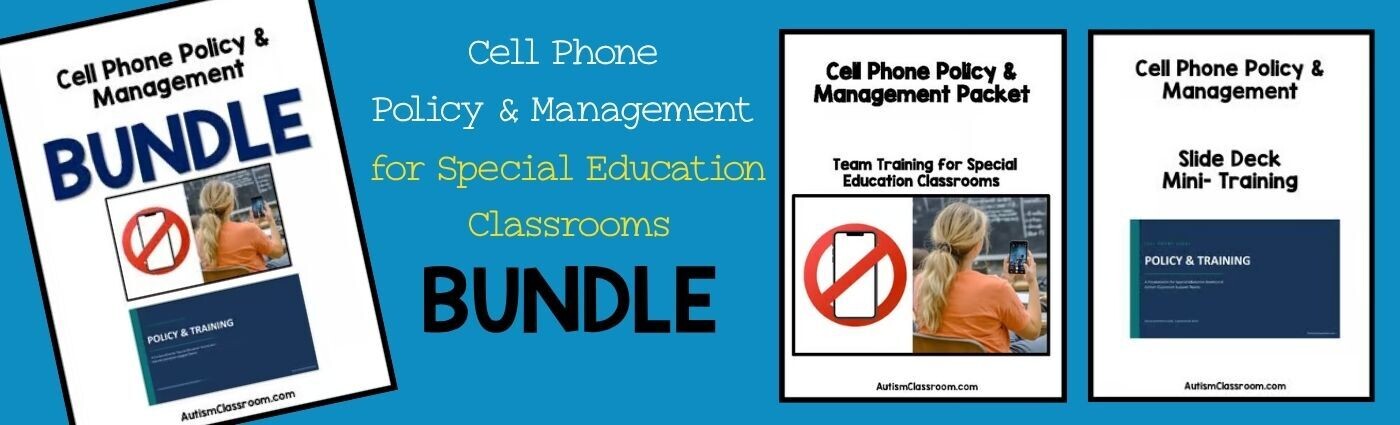
Instead of piecing everything together yourself, this bundle gives you a ready-to-implement framework designed specifically for educational teams.
The Training Presentation
This ready-to-run PDF PowerPoint helps you introduce the policy to your staff in a professional, supportive, and student-centered way. It includes:
- A strong student-focused introduction
- Clear expectations
- Real classroom scenarios
- The Phone Check Board system
- A team commitment component
The Policy & Management Packet
This portion gives you the tools needed to actually maintain the system after training, including:
- A classroom policy poster
- A 2-page staff reflection form with commitment signature
- Tips for instructional leaders
- Two versions of the laminate-and-use Phone Check Board with Velcro cards
Everything is designed to help special education teams stay consistent with miniamizing cell phone use during work.
Because the Goal Is Bigger Than Phones
At the end of the day, this is not really about cell phones. It is more about creating classrooms where adults are present, students feel supported, and teams work together with confidence and clarity.
And honestly, if we survived the pager era, we can absolutely handle keeping our phones tucked away long enough to focus on the important work happening right in front of us.